“Now there was a man in Jerusalem, whose name was Simeon, and this man was righteous and devout, looking for the consolation of Israel, and the Holy Spirit was upon him. And it had been revealed to him by the Holy Spirit that he should not see death before he had seen the Lord’s Christ.”
Lk. 2:25-26
If the story of St. Simeon can tell us anything, it is that the scholarly work of Bible translation is all but boring.
According to patristic tradition, Simeon was one of seventy translators of the Septuagint (the Greek translation of the Hebrew Bible). Now this wasn’t some small task. That top-tier translation task force didn’t operate quite as freely as some modern Bible translators do. I think Simeon would have shrieked, should he have ever gazed upon anything like The Message Bible.
Against all odds, all seventy translators worked on their assigned texts in separate cells and are held to have produced identical translations of the original Hebrew texts. This edition became the Greek Old Testament. I mean, the Greek Old Testament quoted by Jesus and his apostles.
Simeon became doubtful of his translation when he arrived at the verse in Isaiah, “behold, the Virgin shall conceive and bear a son, and shall call his name Emmanuel.”1 He wondered whether to render the Hebrew הָעַלְמָה as ἡ γῠνή (young woman) or as ἡ παρθένος (virgin), seeing as virgins definitionally don’t conceive. But in his moment of doubt, an angel appeared to him and promised he would not die until he saw the fulfillment of this prophecy.2 He then rendered the word as virgin, a truth to which we hold fast.
Fast-forwarding a bit, Simeon saw the continued Hellenization of Israel, the conquest by the Romans, and later, King Herod’s massacre of the Holy Innocents. When Herod heard Zechariah’s wife had given birth, and that the child was nowhere to be found, he interrogated Zechariah about the missing child and had him killed for his refusal to answer.
The Protoevangelium of James, an apocryphal early Church text, tells us that Simeon, who was serving as a priest in the temple, was chosen from among his number to succeed Zechariah as high priest. This gives context for the sudden change between the first two chapters of St. Luke’s gospel. With this in mind, it is also likely that Simeon saw the blessed Virgin Mary grow up in the temple where she spent her childhood in prayer, being fed with the bread of angels.3
All of this is beautiful food for meditation, but more to my point, it shows us that Simeon’s encounter with the Holy Family was no random chance event—it is what he expected. In the midst of all that was happening around him, Simeon knew what the consolation of Israel would look like.
Recounting the beautiful encounter, St. Luke continues:
“and inspired by the Spirit he came into the temple; and when the parents brought in the child Jesus, to do for him according to the custom of the law, he took him up in his arms and blessed God and said, “Lord, now lettest thou thy servant depart in peace, according to thy word; for mine eyes have seen thy salvation…”
Lk. 2:27-30
It is striking that Simeon immediately recognized his savior.
It was revealed to Simeon that he would see the Lord’s Christ before his death, but what he looked upon that day was an infant. After hearing a confusing prophecy and witnessing so much conflict in his long life, Simeon’s wearied eyes were finally granted to gaze upon the savior: the Lord’s promise come to fruition. And he saw the savior not descending from his cherubim throne in the heavens, but rather in the arms of a young virgin.
We can only imagine the difficulty we ourselves might have had in recognizing the fulfillment of our hope in such an unexpected place. After all, at the Passion of our Lord, the crowds chose to release Jesus Barabbas rather than Jesus Christ. They expected the fulfillment of their hope to come in a more obvious way, and we re-echo their words each Passion Sunday: an admission of our own inattentiveness.
I think it was Simeon’s ardent faith in the inspiration of the Holy Spirit—his trust in the Scriptures rather than in his own understanding—that helped him to perceive his salvation in the face of a child. And I like to imagine that his time of translation allowed him to hold especially fast to those nuggets of wisdom from the Old Testament prophecies that escape the eyes of most.
When I think back to the early days of my own conversion, particularly to the long hours I spent translating Greek for class, I am surprised by how much some of those tiny nuggets influenced my understanding of the Catholic life of faith.
Most of those details are ones you may have heard of. There’s Christ’s switch from φαγεῖν (phagein—to eat, consume) to τρώγων (trowgown—to gnaw, chew, devour) when doubling down on the meaning of the Eucharist against the doubts of the crowds in the Bread of Life discourse.4 Or there’s St. Paul’s encouragement to the Philippians to συναθλοῦντες (sunathlountes—to strive together, literally to together-athlete) for the sake of the Gospel, stressing the team-like nature of the Church amid all his references to competition.5 There’s much to be gained by looking back to the Greek.
But perhaps the most interesting thing that spoke to me is from St. James’ epistle: “blessed is the man who endures trial, for when he has stood the test he will receive the crown of life.”6 The crown of life, translated from στέφανον τῆς ζωῆς (stephanon teis zoeis), shares its name with the first martyr Stephen. The connection between martyrdom and the crown of life is somewhat obvious when you think about it, but realizing the innate linguistic parallel served to reinforce the idea in a way that has stuck with me for years. I am thankful the Lord pointed it out to me.
Whether or not we know any Greek, spending time with the Bible helps us to reorient our expectations of God as he works in our lives, allowing us to perceive the fulfillment of our hope where it might go otherwise unnoticed. We know not what the Lord has for us each day, but looking to the example of St. Simeon, we are reminded that praying with the Scriptures helps us to remain ever-vigilant, always ready for the coming of our Lord Jesus Christ.
St. Simeon the God-Receiver, pray for us!
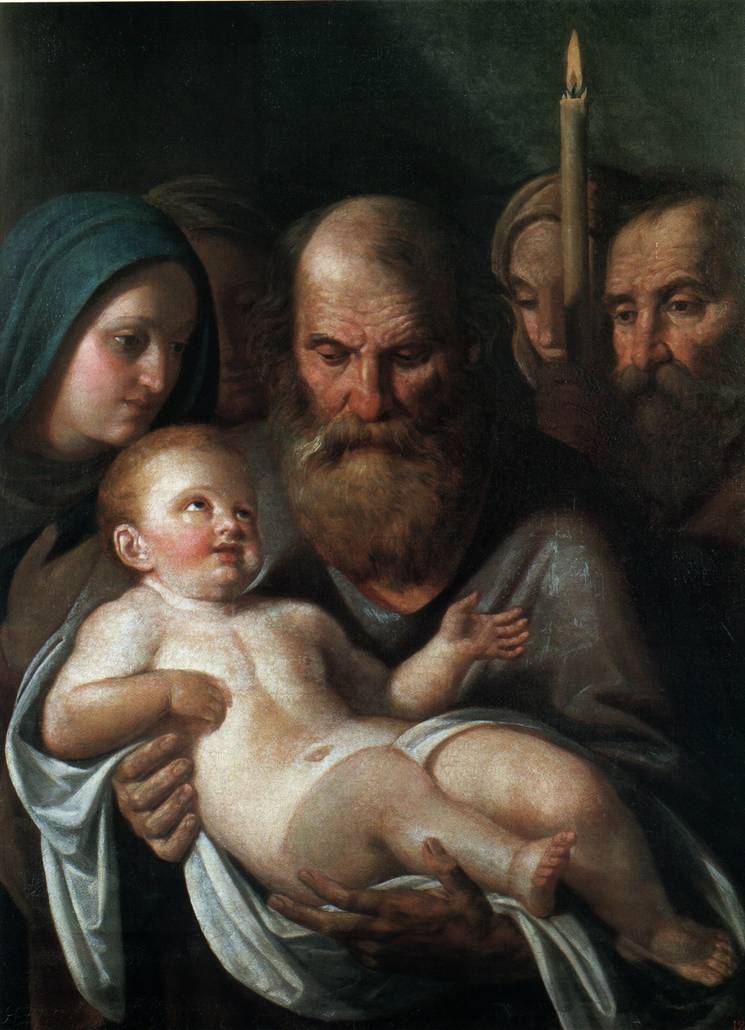
“Simeon the Righteous” By Alexey Yegorov
[1] Is. 7:14.
[2] Жития святых на русском языке, изложенные по руководству Четьих-Миней св. Димитрия Ростовского (репринт). — Киев: Свято-Успенская Киево-Печерская Лавра, 2004. — Т. VI. Месяц февраль. — С. 30—40.
[3] The Protoevangelium of James. Edited by Kevin Knight. Translated by A. Walker. New Advent. Vol. 8. Ante-Nicene Fathers. Buffalo, NY: Christian Literature Publishing Co., 1886.
[4] Jn. 6:50-58
[5] Ph. 1:27
[6] Js. 1:12.
 Ryan P. Both