
In the past few weeks, I have had to say goodbye to three places I call “home.” Now, that I have three places I can call by this name is something for which I am very grateful. When I was at Holy Trinity in Dallas, I would often make trips to my home parish in Waco, only to drive back home to the seminary that same evening. And on breaks, I traveled back to Seattle to spend time with my family at home. My frequent travels home(s?), particularly in this time of transition, have raised the question, what is home?
We typically fall into one of two camps when it comes to home: we think of home either as it concerns place, or with regard to experience. This much is revealed by how we talk about home, especially through our use of aphorism and cliché. Despite their ambiguity and the lack of understanding with which they are sometimes used, these expressions can serve as helpful entries into understanding how we think about home.
On the place side of things, we say things like “there’s no place like home,” and “home is where one starts from.” In these sorts of expressions, we generally mean to refer to the place whence we came (i.e. where we were raised, be it a house or city) or where we currently reside. Whether by home we mean a whence or a where, it is clear that the notion is meant to indicate a place of physical stability. However, we are increasingly reluctant to define home in terms of place. And to be fair, very few people, if any, would hold that home is merely a place. Still, we talk about home in this way, and thus we should consider it (even if only to refute it).
But on the experiential side of things, expressions such as “home is where the heart is,” and “you can’t go home again” suggest that in our consideration of home, we actually consider more than just physical stability. This is, in part, because we live in an age beset by physical instability—by the increasing prevalence of housing insecurity, migration, war, and natural disasters. But perhaps this reluctance also stems from a growing emphasis on the emotional stability home ought to afford us.
This is the trending idea of home, and it is especially prevalent in today’s music, which sings to a world grappling with its own transience. The catchy and (I think) rather popular song Home by Edward Sharp and the Magnetic Zeros speaks to this point rather interestingly. I imagine it is a dialogue between two vagabonds in love who sing in a traveling band. “Oh home. Let me go home. Home is whenever I’m with you.” Home, here, is no longer meant to designate a place—a whence or a where—but when and a whom. It is taken to indicate the experience of a relationship.
Since the idea of home as a place is thought to expose us to instability, we turn instead to relationships for a sense of stability. In one homily, St. John Henry Newman points to the transient and unstable nature of the world as “why a great number of the better sort of men look forward to marriage as the great object of life. They call it being settled, and so it is.” In his search for a sense of home, man often turns to the goods of marriage, family, and friendship in its stead. But while these relationships are significant and even indispensable to one’s experience of home, they can also fail to deliver the stability we desire in the idea of home, such as in cases of divorce, grief, or severe conflict. Further, these relationships are not identical to home itself. When describing our relation to home, we do not say “I am with home” or “I am going to be with home,” but rather “I am at home” or “I am going home.” We may “feel at home” in the company of another, but it is obvious even in our use of the term that by home, we mean something other than those people with whom we share it—whatever it is.
So turning now to what home is, we should consider that we are human persons composed of body and soul. Any notion of home that treats only one part of our humanity is bound to be either materialistic or gnostic. Just as home cannot be a mere place, since this would neglect our nature as rational and relational beings, it cannot be considered a mere experience, since this would be a rejection of our bodiliness. Home, then, ought to be considered something of stability with respect to both body and soul—to both place and the relations therein. It is the set of stable external conditions that dispose us to stability of heart.
But this great stability of heart for which we pine cannot be fulfilled in this passing world. St. Paul writes in his letter to the Philippians, “our citizenship is in heaven, and from it we await a Savior, the Lord Jesus Christ, who will transform our lowly body to be like his glorious body, by the power that enables him even to subject all things to himself.” As Christians, we look forward to the resurrection of the body and to life everlasting: to a new heaven and a new earth where there will be no more sea—no more chaos, nor sin, nor strife—and where we will find rest of body and soul, at last. Home, not being of this present world, is neither a whence nor a where… neither a whom nor a when… but a whither. As Christians, we are headed home.
We are a pilgrim people in this life, and we are being led to an eternal dwelling in the Father’s house in communion with all his saints. Later in the same sermon quoted above, Newman exhorts his congregation: “What fellowship can be more glorious, more satisfying than that which we man hold with those inmates of the City of God whom St. Paul enumerates? Leave then this earthly scene, O virgin soul, though most attractive and winning; enter into the tabernacle of God.”
Now this is all good and pious—and perhaps even obvious—but what does it have to do with things here and now? What about this place and these people that I have come to associate with home? How do I understand home in light of heaven?
The experiences of home we have here should ultimately draw our hearts and minds to desire heaven. The joys of fellowship with friends and family, and temporary reprieve from toil afforded us by our earthly dwelling, and comfort we find in these things truly help us anticipate things to come. And conversely, the transience of this passing world is a reminder that we are made for rest in God alone.
The most perfect anticipation of our heavenly home is experienced at the Sacrifice of the Holy Mass. As we approach Holy Communion, our wearied knees find rest on the sturdy, stable threshold of heaven’s gates, as it were. And as we partake of that Food for the Journey, we are drawn into communion with Christ and his entire mystical body. It is above all here, at this sacred place and with this pilgrim people, that all are offered a foretaste of their true and heavenly homeland.
“Listen graciously to the prayers of this family, whom you have summoned before you: in your compassion, O merciful Father, gather to yourself all your children scattered throughout the world. To our departed brothers and sisters and to all who were pleasing to you at their passing from this life, give kind admittance to your kingdom. There we hope to enjoy for ever the fullness of your glory through Christ our Lord, through whom you bestow on the world all that is good.”
Eucharistic Prayer III
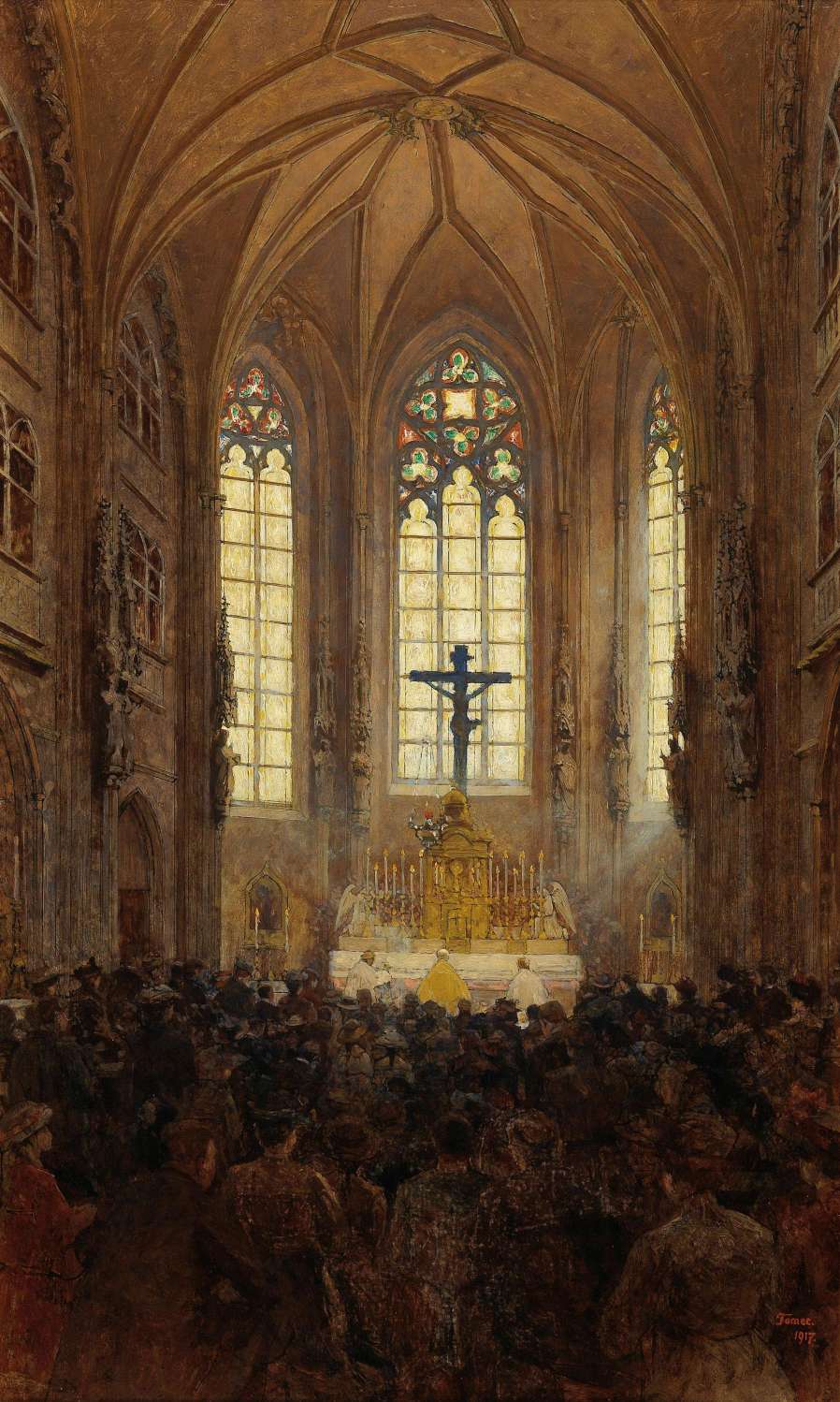
“Solemn Mass in the Hofburg chapel” by Jindřich Tomec
 Ryan P. Both