
In the beginning of my time at Baylor, my college roommate Shaler took a class on the Gospel according to St. John. I distinctly remember one night when he returned to our dorm with the enthralling news that the narrative structure of this Gospel used chiasmus. Like most people, I imagine, I had absolutely no idea what that was. He explained that chiasmus is a literary device used to emphasize a particular word, phrase, or idea. This end is accomplished by an author enveloping his central point in unfolding layers that mirror one another either by opposition or parallelism. Named after the Greek letter X (chi), the device’s structure looks like an X, and it appears in everything from the writings of St. Augustine, the poetry of T. S. Eliot, the stories of J. R. R. Tolkien, and the music of the Oh Hellos.
This classic Roman epithet is a helpful and straightforward example of Chiasmus:
“What you are now, I once was;
what I am now, you will become.”
Breaking it down, we see:
   A1 - What you are now
      B1 - I once was
      B2 - What I am now
   A2 - you will become
Or, more visually:
A1 - What you are now             B1 - I once was;
        ╳
     B2 - what I am now             A2 - you will become.
The point of this epithet is that you, the reader, and its “author” share the same mortality. The corresponding outside layers (A) are spoken to you, who are still living but fated to die; the corresponding inside layers (B) are spoken of the one who now is dead but once was living. The parallel structure of the epithet and the shifting of tenses helps emphasize the author’s argument. It packs a greater punch than saying something like, “everyone dies,” or “we all share the same fate.” It draws our attention all at once to the similarity between ourselves and the author in our fate, and to the stark separation between life and death.
Not all chiasmus is used for the sake of rhetorical punch, but it does draw our attention to contradiction, similarity, and paradox in a unique way.
Now, back to St. John’s Gospel. It’s worth noting that St. John frequently weaves chiasmus into individual verses and passages. But rather than searching out these smaller instances of chiasmus, Shaler and I stayed up late into night digging through the entirety of the Gospel, looking at how the narrative was framed and what it was meant to emphasize.
We found some decent indications of at least one chiastic narrative structure, which I list below with chapters:
A1. The Eternal Word enters temporality (i)
  B1. John the Baptist precedes Christ, baptizing with the baptism of water (i)
    C1. Christ is baptized in the River Jordan (i)
                    M1. Christ calls the disciples when they are fishing (i)
      D1. Christ turns water into wine, “My hour has not yet come,” ministry commences (ii)
                      N1. Living Water Discourse, Bread of Life Discourse (iii, vi)
        E1. Feast of Tabernacles, Mount of Olives, Temple, Guilty woman pardoned (viii)
          F1. “Where I am going, you cannot come” (viii. 21)
                             W1. Lazarus dies (xi)
                                 X1. Jesus raises Lazarus from the dead, last public miracle (xi)
                                     Y1. The Jews plot to kill Christ for this miracle (xi)
                                         Z. Jesus is anointed by Mary of Bethany (xii)
                                     Y2. The Jews plot to kill Lazarus in light of Christ’s following (xii)
          F2. “Where I am going, you cannot follow” (xiii. 36-38)
                      N2. Last Supper Dialogue (xiv–xvii)
        E2. Grove of Olives before the Feast of Passover, Temple, Guilty man pardoned (xviii)
      D2. Jesus rejects wine on the Cross, pours out blood and water, “it is finished,” ministry consummated (xix)
                                 W2. Christ dies on the cross (xix)
    C2. Christ is buried (xix)
                               X2. Christ is raised from the dead (xx)
                    M2. Christ appears to the disciples when they are fishing (xxi)
  B2. Christ sends the apostles for the baptism with the spirit, Peter to tend the flock (xx–xxi)
A2. There are not enough books to contain all Christ did (xxi)
There seems to be one generally Chiastic structure that spans the whole text (A-F), some more sporadic parallels (M, N), and a much more obvious one at the center of it all (which I have laid out as W-Z). This one revolves around the death of Lazarus and the events at Bethany, and it resolves more gradually throughout the second half of the Gospel. As you can see, it’s not perfectly symmetrical. And it’s obviously a thing of conjecture: the late night finding of two friends’ reading in Alexander Hall. But the patterns that seem to thread the Gospel are undeniably thought-provoking.
Many of these Gospel events parallel one another intuitively. One such example is Christ’s first miracle at the wedding at Cana and his words to his mother, “my hour has not yet come,” being paired with the rejection of wine on the cross, the outpouring of blood and water, and the last word “τετέλεσται,” “it is consummated.” And likewise, it is clear what the Holy Spirit inspired St. John to emphasize by recording such details in the Gospel. No other account of the Gospel recounts this first miracle, nor do any give us those particular words of Christ on the cross. By divine inspiration, St. John sets them opposite one another in his narrative arc. He thus offers us a hermeneutical key to engage more deeply those particular mysteries of Christ’s life. Each detail, being situated in the context of this chiasmus, informs our understanding of that which sits on the opposing page. We are made to understand what Christ whispered to his mother at Cana, the true significance of his first miracle, in the light of his death; in the light of his first miracle, we see the crucifixion more fully as the hour that was to come, the true wedding between God and his Church.
But with respect to the whole, which is not merely a number of individual parallelisms serving as hermeneutical keys to one another, the chiasmus in the Gospel of St. John draws our attention to a rather unsuspecting focal point: the events at Bethany after the death of Lazarus, an episode upon which I will later expound at length.
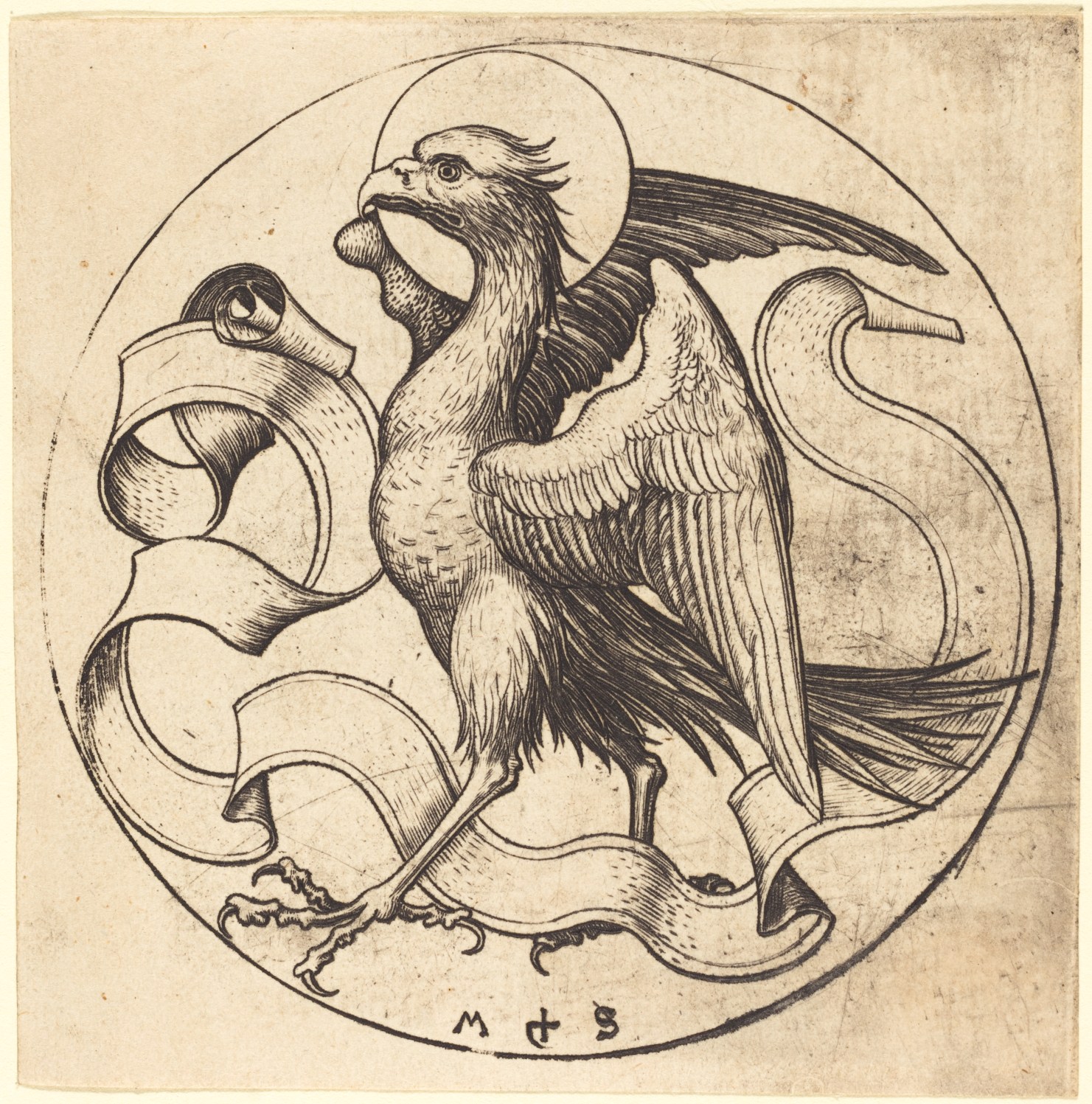
“The Eagle of Saint John,” Martin Schongauer
I look forward to resuming my blog activity with more regularity than before. (And particularly more than this summer.) Classes just began a few weeks ago, which has already afforded me a refreshing sense of structure and routine. Prior to that, I spent the summer in Nebraska, completed a silent retreat, returned home briefly, packed up my belongings, and moved to Italy, where I have been living for three months now. Please keep me and all whom I encounter in your prayers.
 Ryan P. Both