
Seeing as I have written several short essays on the topic of fasting, both during Advent and Lent, I think I ought to devote some time to a reflection on the topic of feasting before the season of Easter concludes entirely. Feasting is one of the great joys of being Catholic: celebrating the festival days of patron saints, our Lady, and of God himself by enjoying rich food, good drink, and dear company, so as to worthily engage those realities which most fundamentally shape our lives. Feasting is not just an antiquated custom or fun ideal, but a biblical mandate! Christ, our Paschal Lamb, is sacrificed; therefore let us keep the feast! As we conclude the Easter season, I hope to offer some thoughts that we can take with us into the rest of the year. Truly, every Friday is a small Good Friday, and every Sunday is a feast of the Resurrection.
There is a certain mythic character which enshrouded the idea: hearing the word “feast” often evokes images of great banquet halls, of tables topped with rich foods, with beverages abounding and songs resounding, and of a warm cheer in light of a single idea or event. Reading this, one might find themselves reminded of Bilbo’s eleventy-first birthday party, the bottomless banquets of Hogwarts, or the elegant dinners seen on BBC’s Downton Abbey. The notion of feasting captures the imagination of modern man because it is largely foreign to him. Before my conversion to the Catholic Faith, feasting was something of which I had practically no knowledge or experience. I think this is the case for many of us who, though we celebrate birthdays and some holidays by feasting—often with some of the same externals as are found in these fictional festivals—these celebrations can often fall flat when compared to the ideas we have of a proper feast. Either the food is not as rich as it appears in the eyes of our imagination, the conversation falls flat, or the activity of feasting just feels out of place when compared with how we spend the rest of our lives.
While the feasts of literature are often mythic and extraordinary, they are firmly rooted in a tradition that has only been lost to time. The ability to feast well, I believe, has been lost in proportion to our ability to fast well, to distinguish between feasting and indulgence, and to understand the proper end of feasting—our sanctification. Recovering a proper understanding of feasting in our Catholic culture thus ought to involve a proper understanding of its preparation, manner, and aim.
What has Feasting to do with Fasting?
One of the most striking things I’ve noticed since becoming Catholic is the depth of sorrow experienced by the Faithful on Good Friday and the ensuing height of joy seen on Easter. On Good Friday, it is not uncommon to see people weeping during the veneration of the cross, grieving the sins which crucified their Lord. The rest of the day is marked by an eerie silence—akin to that of a funeral—which is almost felt. This gravity is particular to the Church at the height of her penitential time. And conversely, I have never seen smiles so grand, nor so many tears of joy, nor looks of joyous relief as when the lights are turned on throughout the darkened Church at the Easter Vigil. No more sincerely does anyone sing et in terra pax! or alleluia! than at the rising of Christ from the dead after a long and somber season of penitence. The celebrations that follow are markedly bright. The heaviness of Lent is lifted, and the light of the risen Christ dwells in our hearts as we feast.
It is a proper relationship between fasting and feasting which disposes us to do both sincerely. In his homily Keeping Fast and Festival, Newman remarks, “none rejoice in Easter-tide less than those who have not grieved in Lent. This is what is seen in the world at large. To them, one season is the same as another, and they take no account of any.” The problem I faced before my conversion to Catholicism is that Good Friday and Easter Sunday seemed as though isolated incidents. Nothing of note preceded Good Friday to prepare me for it, and this, in turn, led to an unsustained joy at Easter. Christ was risen! But how long had I thought about his death? And how much less time had I spent considering his sufferings? Truly, without the proper preparation for Easter, I was not disposed to celebrate it well.
By way of analogy, we might consider the wedding of two acquaintances with whom one has surface-level interactions. In this case, one might share in the happiness of this couple to a certain degree, keeping in mind the good of the situation and conforming himself to the tenor of the room, but this happiness is quite unlike the happiness one experiences for the beloved couple whom he has known since before their relationship began, and whom he has seen persevere through many challenges and trials—even sharing in those to a degree by his prayers and conversations. While one may celebrate the wedding of the acquaintances, he has not shared in their lives as deeply as he has with the other couple. In such wise, he is much better disposed to celebrate meaningfully that couple with whom he has shared so much. This disposition, I believe, proceeds almost naturally from the care and concern he has practiced for those friends for so much time.
And so it is with Christ, who tells us unequivocally, “if anyone would come after me, let him deny himself and take up his cross daily and follow me.” If we wish to follow Christ to his resurrection and ascension into heaven, we must first follow him to the cross. Throughout Lent, we accompany him in the desert. Throughout Holy Week, we walk with him as he enters into his Passion. On Holy Thursday, we keep vigil with him in the garden. On Good Friday, we follow him to the foot of the Cross. On Holy Saturday, we mourn his absence. And on Easter, we rejoice because our friend—with whom we have walked so long, and who has been so patient with our many missteps—has risen from the dead. If we have died with him, we will also live with him; if we suffer, we will also reign with him. Newman continues, “it is often said, and truly, that providential affliction brings a man nearer to God. What is the observance of Holy Seasons but such a means of grace?” By entering deeply into the eason of Lent, we may more deeply enter into the festivity of Eastertide.
Why do we Feast as we do?
Now, the idea of celebrating the Church’s solemnities is a sensible thing. After suffering with Christ through all of Lent, who would think it wrong to rejoice in his resurrection? Still, though, the idea of feasting properly can be quite foreign to the mind of modern man. This is particularly true when such feasts involve the consumption of alcohol and great rich foods—both of which can, for our post-puritanical sensibilities, raise the questions, is this necessary? Is this Christian? How does this have to do anything with what we’re celebrating?
There is a great cognitive dissonance today between religious observance and literal feasting. In part, this might stem from the association between the secular world and events which involve drinking and festivity. The Christian difference in this regard is threefold. Firstly, while the world indulges the sensual desire of appetite (without first having fasted), Christians ought feast with the virtue of temperance. Secondly, while the world often indulges in a mindless way, Christians ought to feast with a sense of reverence. Thirdly, while the world’s celebrations are self-reverential, the Christian’s feasts are ordered toward something outside themselves. As such, we ought to feast with temperance, reverence, and a spirit of devotion.
Beginning with temperance, we know from Aristotle that this is the virtue between intemperance (which in the context of feasting look something like the worship of pleasure) and insensibility (which in the context of feasting would mean the rejection of one’s bodiliness). Temperance, he explains, is the virtue that moderates pleasure and pain. On the occasion of feasting, we ought not eat and drink to the point of gluttony or drunkenness, nor eschew food and drink on the grounds that such things are below us or unneeded. Rather, as Scripture tells us, the Lord provides “wine to gladden the heart of man, oil to make his face shine and bread to strengthen man’s heart.” In a word, food and drink are ultimately good. They flow from God’s providence, and they supply for our need and our enjoyment when received in proper proportion. Avoiding intemperance—that is, either the hatred of food or the excessive love thereof—is achieved through the prescribed periods of fasting in the life of the Church. By engaging these times well, we come to see food and drink in a more proper light.
As for why food is appropriate for a feast at all, though, we should remember that at the end of a season of fasting, we are not altogether different beings than we were at the start. We are perfected through penitence, but we remain human. St. Thomas reminds us, grace perfects nature. In his book The Purple Headed Mountain, Martin Thornton describes St. Mary Magdalene as the key to understanding this principle:
“The glorious thing is that she was converted and did not change at all; she changed her way of living but she never changed herself, she never turned into a different woman… She remained a woman of impetuous, generous, full-blooded love, she had to express herself physically, through her senses, she could never be content with the ‘spiritual’ religion which once pretended she had no body and no passion. Once she kissed and caressed her revolting clients; now she kissed and caressed the feet of Christ, pouring tears of penitence upon them and wiping them lovingly, not with a towel but with her hair, with a physical part of herself…”
God, then, is not understood to take away our physicality, but rather to reshape the way in which we understand and relate to it. After Lent, we do not lose our enjoyment of food, but rather we enjoy it in its proper proportion; what we once enjoyed without moderation, we now appreciate more fully in virtue of the temperance acquired through penitence.
With regard to reverence, I believe this is more easily understood even to the secular world. We, as a culture, have begun to see what is wrong with the culture of fast food. It is consumeristic, isolating, and alienating. That we have realized the problem is evidenced by the growing “slow food” movement. Feasting as a Christian community begins and ends with prayer. It involves eating mindfully with a spirit of gratitude to God, both for the food and for his work in salvation history. And feasting in a more classical fashion necessarily involves community. I should note here, that while we can feast with any group of people celebrating Christmas or Easter, there is something particularly fitting about feasting within the community with which we have fasted.
The Proper End of Feasting
Devotion, the third thing which I believe furthest distinguishes worldly indulgence from the Christian feast is that Christian feasting is done for devotion to God; feasting helps us to order our lives toward heaven and set our minds on things above, not things below. I won’t belabor this point, but I think it is worth considering this verse from Nehemiah: “This day is holy to the Lord your God; do not mourn or weep… Go your way. Eat the fat and drink sweet wine and send portions to anyone who has nothing ready, for this day is holy to our Lord.”
The particular fittingness of feasting in a phsyical manner with food and drink—besides that it is fitting for our nature and aided by a spirit of gratitude—is that it reminds us of the joys of heaven. I do not know what heaven is like. Eye has not seen, and ear has not heard. But the many passages describing the banquet evoke imagery of a great banquet. When we celebrate feasts of the Lord, we anticipate the joys of heaven, where the saints enjoy the eternal wedding feast of the Lamb.
Christ, our Paschal Lamb, is sacrificed; therefore let us keep the feast, not with the old leaven, the leaven of malice and evil, but with the unleavened bread of sincerity and truth.
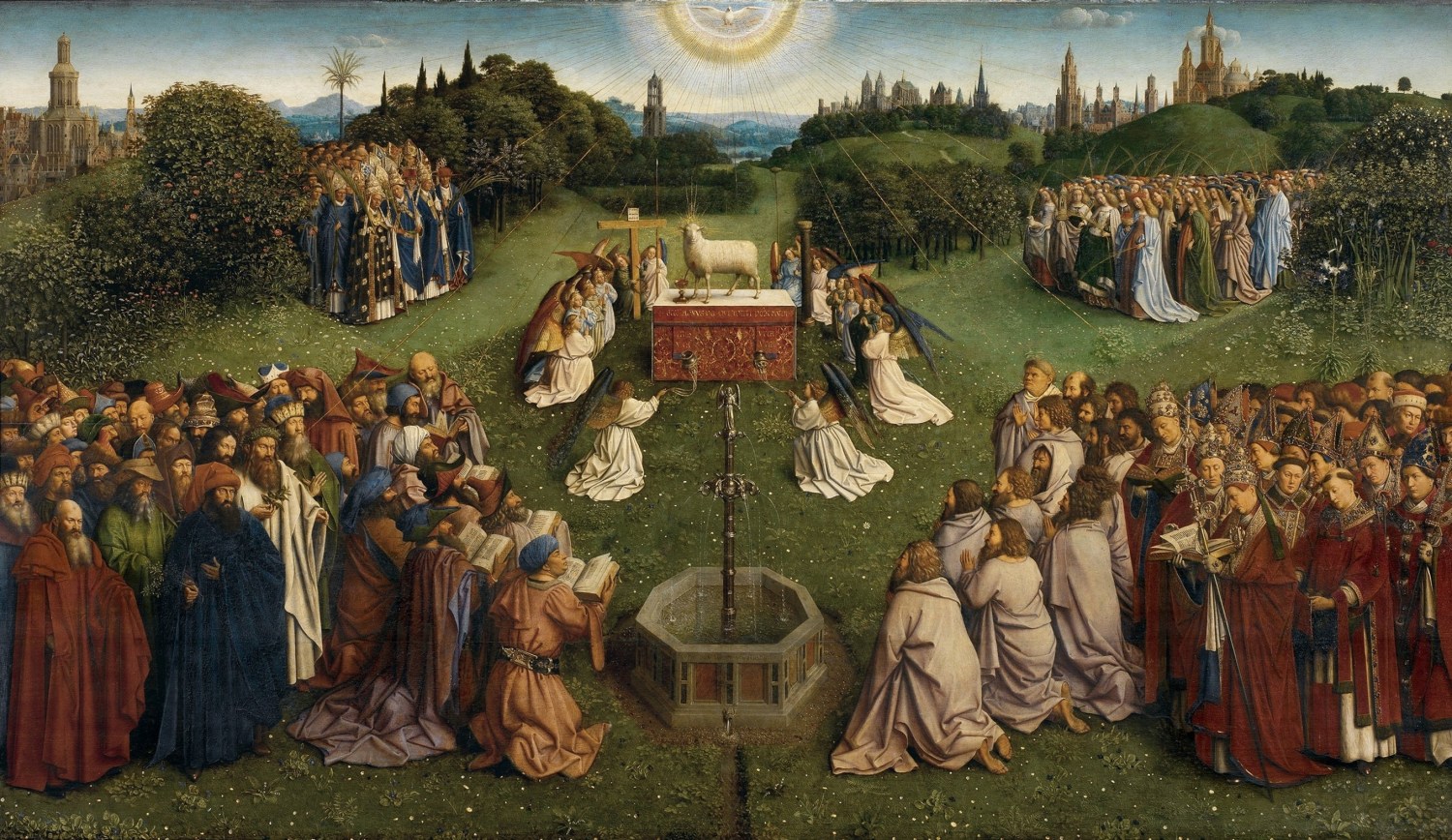
Ghent Altarpiece, Adoration of the Lamb, by Jan van Eyck
 Ryan P. Both