
The story of the Transfiguration sometimes catches me a bit off guard at mass. It pops up in the lectionary on August 6 and on the second Sunday in Lent, and we meditate with it whenever praying the luminous mysteries of the Rosary. As such, we really should expect to hear it at these times, but the question is, why? The frequency and context in which it is offered gives an impression that it is a timeless story. That is, a story that could be told without respect to time—one that may as well be read on any number of occasions. And, after all, it is read on a number of occasions. In turn, this seemingly timelessness quality of the Transfiguration raises the question, why am I hearing it during Lent? Being timeless and all, it seems like it doesn’t have much to do with Lent at all! It’s a question I’ve heard before, and it’s a question to which I’ve considered and given some thought, myself.
St. Mark tells us in his account of the transfiguration, “after six days Jesus took with him Peter and James and John, and led them up a high mountain apart from themselves, and he was transfigured before them.”
If we read this like any other excerpt from the lectionary, we might tend to read it in the same vain as “in those days, he led them up a high mountain,” or “at that time, he led them up a high mountain.” But St. Mark tells us he led these disciples up a high mountain after six days: six days after informing them of the suffering they were going to endure. “Whoever would be my disciple must take up his cross…” he tells them. “Whoever would save his life will lose it… whoever loses his life for my sake will save it…” “Whoever is ashamed of me and my words,… of him will the Son of Man be ashamed when he comes in glory.”
So when he takes them up a mountain to be transfigured, this has been in the back of their minds for six days: that to save their souls, they must endure persecution, suffer, and give their lives. At the outset, this future must have appeared bleak to the disciples. They left their nets to follow Christ, but after hearing about suffering and death time and again, perhaps they began to reconsider their initial decision. I imagine they became fearful in light of these prophetic utterances.
Perhaps they imagined these imminent sufferings to be unbearable… Shrinking from the thought, perhaps they thought about what it might be like to take their nets back up… Fishing wasn’t so bad, was it? This reaction to suffering is one to which we may all relate in some way. In our pursuit of holiness, we can be tempted to give up, to look back, and so lose sight of God’s glory.
Our Lord had told them about his glory before, but so far, they had much more experience of persecution by the Pharisees and Scribes than they had experience of any glory. So after six days, he led them up a high mountain and was transfigured before them. This is where we encounter the Lord in today’s Gospel. He was transfigured and so by showed forth the glory which would follow his passion, death, and resurrection. With this, he gave them consolation: evidence of the glory that awaits those who are willing to suffer.
In the Church’s iconographic tradition, saints are almost unilaterally depicted with halos around their heads. These halos remind us of the glory of God—the glory of which the saints partake in heaven; having been perfected in charity, they radiate the light of God’s splendor. In images of Christ, you will likewise find a halo, but in it you will often find the outline of a cross. (This is particularly common in the Christian East.) More than this just being an easy way of identifying Christ in various images, this feature serves to remind us of the inextricable connection between Christ’s passion and his glory: that he did not ascend into heaven without undergoing the cross.
The same is true of the saints, and the same is asked of us. St. Paul writes in his Epistle to Timothy, “if we suffer, we shall also reign with him,” and in his Epistle to the Galations, “far be it from me to glory except in the cross of Jesus Christ.” It is one thing to marvel at God’s glory, but it is another thing entirely to glory in his cross. We want to relish in his consolations, but not to share in his sufferings. At the sight of suffering, it is easy to recoil and eschew our means of sanctification…
The Transfiguration, then, is not just a miraculous show of God’s power, but an invitation to endure discomfort, annoyance, slander, derision, trial, violence, exclusion, and even death, knowing that at the end of those sufferings we suffer for Christ, there awaits glory and a peace that surpasses all understanding. God gives us a glimpse of his glory such that we might remain encouraged throughout every earthly trial. Lent is an arduous time, but one in which we are encouraged to remain steadfast by setting our hearts on what is ahead. If we unite ourselves to Christ in our sufferings, we will be united with him in his glory.
“Nevertheless I am continually with thee;
thou dost hold my right hand.
Thou dost guide me with thy counsel,
and afterward thou wilt receive me to glory.”
Ps. 73:23-24
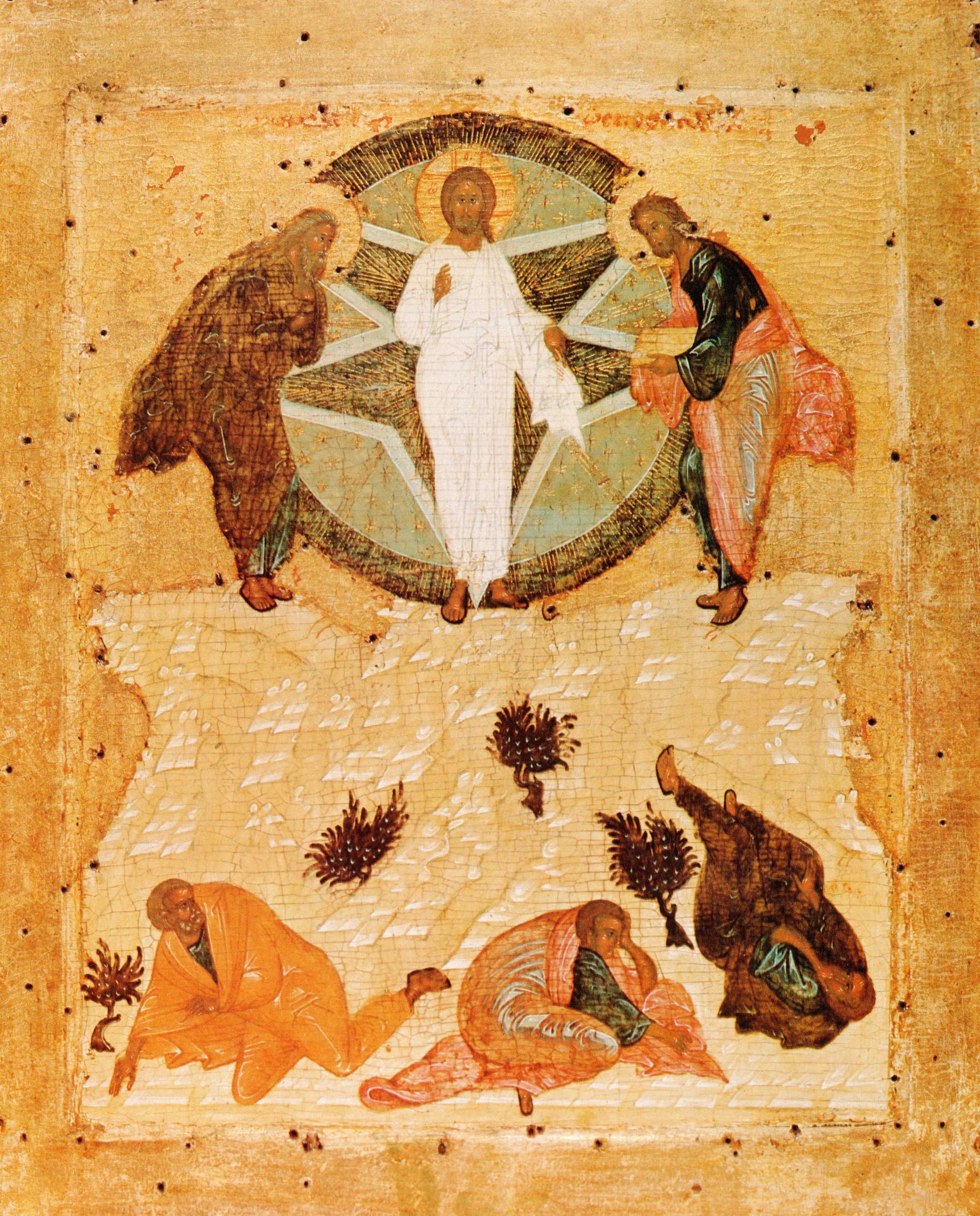
Russian Icon of the Transfiguration, 15th C.
 Ryan P. Both