
A reflection on Mt. 14:22-33, the story of Christ and St. Peter walking on water before Christ calms the storm.
“Lord, if it is you, command me to come to you on the water.” These words of St. Peter should strike us as strange. For context, after ten hours of being buffeted about by great waves and winds, Christ—the God of all creation—has just appeared. As He stands on top of the water in front of the disciples’ boat, the disciples wonder whether He’s a ghost. But Peter cries out, “if it is you, command me to come to you on the water.” Not the reaction you might expect. I think if many of us were there, we might have called out “Lord, if it is you, command the waters to stop,” or perhaps more simply, “Lord, help!”
Throughout the Gospels, our Lord performs many remarkable miracles. He heals the sick, casts out demons, calms storms, forgives sins, and raises the dead. By doing such a variety of miracles, He shows us His divinity in a number of different lights. For example, He heals the sick to show us His power over the body, casts out demons to show us His authority over the soul, and raises the dead to show us that death itself yields to His command. The miracle in this Gospel, we will see, is a bit different.
There are two stories of Christ calming a storm in the Gospels. Sts. Mark and Luke give us the story of Christ asleep on a boat, awakened by the disciples as the storm hits, and calming the storm. But this story, given to us by St. Matthew, is a rather different one.
Unlike the other story of Christ calming a storm where we find Him asleep on the disciples’ boat, this Gospel begins with Christ a ways off… he’s praying on a mountain—alone—while the disciples’ boat is rocked tempestuously by the storm. “The boat,” Matthew describes for us, “already a few miles offshore, was being tossed about by the waves, for the wind was against it.”
And again unlike the other story where the disciples beg our Lord to calm the storm rather quickly, here in this Gospel He lets the boat be battered by the winds and the waves for hours on end—until “the fourth watch of the night.”
And further still, in this Gospel He doesn’t calm the storm immediately, but rather He waits to do so until He has done three things. First, the Lord approaches the disciples, “walking on the sea.” Second, He allows Peter to walk out onto the water with him. Third, when Peter becomes afraid and begins to fall, the Lord saves him.
Why does Christ wait so long to calm the storm? He could easily have done so at any other point in the story: as He was praying on the mountain, as He was walking out to meet the disciples, as Peter began to walk out on the water, or perhaps especially as Peter began to fall! Why is it only after this is all said and done that He finally stills the waves? After all, He was swift to act in the other storm. But then again, this is a different kind of miracle.
I imagine the disciples might have become frustrated—even upset—that the Lord waited so long to calm the storm. We might often do the same. It’s easy for us to become impatient with the Lord when he seems to delay in taking away pain, trial, or temptation.
Let’s consider for a moment how this story might have ended if Christ had calmed the storm much earlier… Perhaps from the top of the mountain He could have stretched out His hands over the sea, illuminated by the glow of the moon, and commanded the sea to still itself. The disciples would have fallen down before Him on the boat in awe—in admiration for yet another manifestation of His power. But in this miracle He isn’t seeking admiration. Perhaps from where He was standing outside the boat, He could have calmed the storm, bidding Peter to walk onto the tranquil waters. Had Christ done this, perhaps Peter might have realized that the winds were no match for the Lord, and once again he might have fallen down in admiration. But in this miracle He isn’t seeking admiration.
The distinctive part of this story is that our Lord and St. Peter walk on top of great waves. It’s not only a testament to God’s power over the water, but also a testament to the transformative power of Faith. Peter steps into a stormy sea by Faith, and by this act of Faith, he illustrates for us what it means to be not only an admirer of Christ, but an imitator—a disciple—of Christ. Writing on this distinction between admirers and imitators, one thinker describes it this way:
“The difference… is between being, or at least striving to be, what one admires—and being personally detached… The admirer will make no sacrifices, renounce nothing, give up nothing earthly, will not transform his life, will not be what is admired, will not let his life express it—but in words, phrases, assurances he is inexhaustible about how highly he praises Christianity. The imitator, however, aspires to be what is admired.”1
This difference between admiration and imitation resounds clearly throughout the words of Christ: “If any man would come after me, let him deny himself and take up his cross and follow me…” “Every man who hears these words of mine and does not do them will be like the foolish man who built his house upon the sand…” His message is clear: we can admire Him from a distance—thinking His words are rather nice—but Christian discipleship requires a certain closeness that is only possible by denying ourselves, taking up our crosses, and following in His footsteps. To be an imitator requires stepping out of the boat, as it were.
Peter steps out in Faith, trusting that Christ is the surest and safest destination in the tempest. He may have been an admirer when he was in the boat, but in Faith, he steps out and shows us what it means to be an imitator of Christ—“one who aspires with all his strength and will to be what he admires.” He begins to fall only when he becomes fixated on the wind, wondering if the wind is greater than God. But God saves him.
This miracle is meant not just to show us Christ’s command over the storm by stilling it, but also to illustrate His ability to sustain us, lead us, and lift us up as we endeavor to follow Him even amid the largest of waves and harshest of winds. He will keep us afloat if only we would step out of the boat like Peter. This miracle should help us understand that Christ does not need to calm the waves for us to tread them underfoot by His grace. God could easily calm every storm, level every mountain, and clear every patch of thorns that stands between us and Him; there is nothing beyond His power. God could take away all difficulty, all pain, all persecution, and all fear, such that we could look at Him with great admiration.
But our God is the crucified God.
We admire Him, yes, but we admire Him most especially as the God who carried His cross, died upon it, passed from life to death, and death to life, and who helps us to do likewise. He doesn’t take away the storms of life because He means to help us rise above them.
St. Peter admires Christ so much that he seeks to be like Him. This is the life of Faith. This is the life of a disciple.
“Lord, if it is you, command me to come to you on the water,” Peter cries out. “Come,” Christ says to Peter, ‘not through the still waters, but through the giant waves. Come not through the gentle breeze, but through the great wind. Come not through where the ground is firm, but through water.’ Our Lord is not one who ascended into heaven after a life of tranquility, but after a life of trial. But in all this, He assures us with words of true comfort, “come unto me, all you who are weary and are heavy laden, and I will give you rest.”
I like to imagine that it was this stormy episode that was playing back in Peter’s head as he composed his first Letter. “Christ… suffered for you,” he writes, “leaving you an example, that you should follow in His steps…” “Cast all your cares on Him, for He cares for you.” In taking up our crosses, casting our cares on Christ, and trusting in His grace as we imitate Him amid the storms of life, we are changed more and more from admirers into disciples.
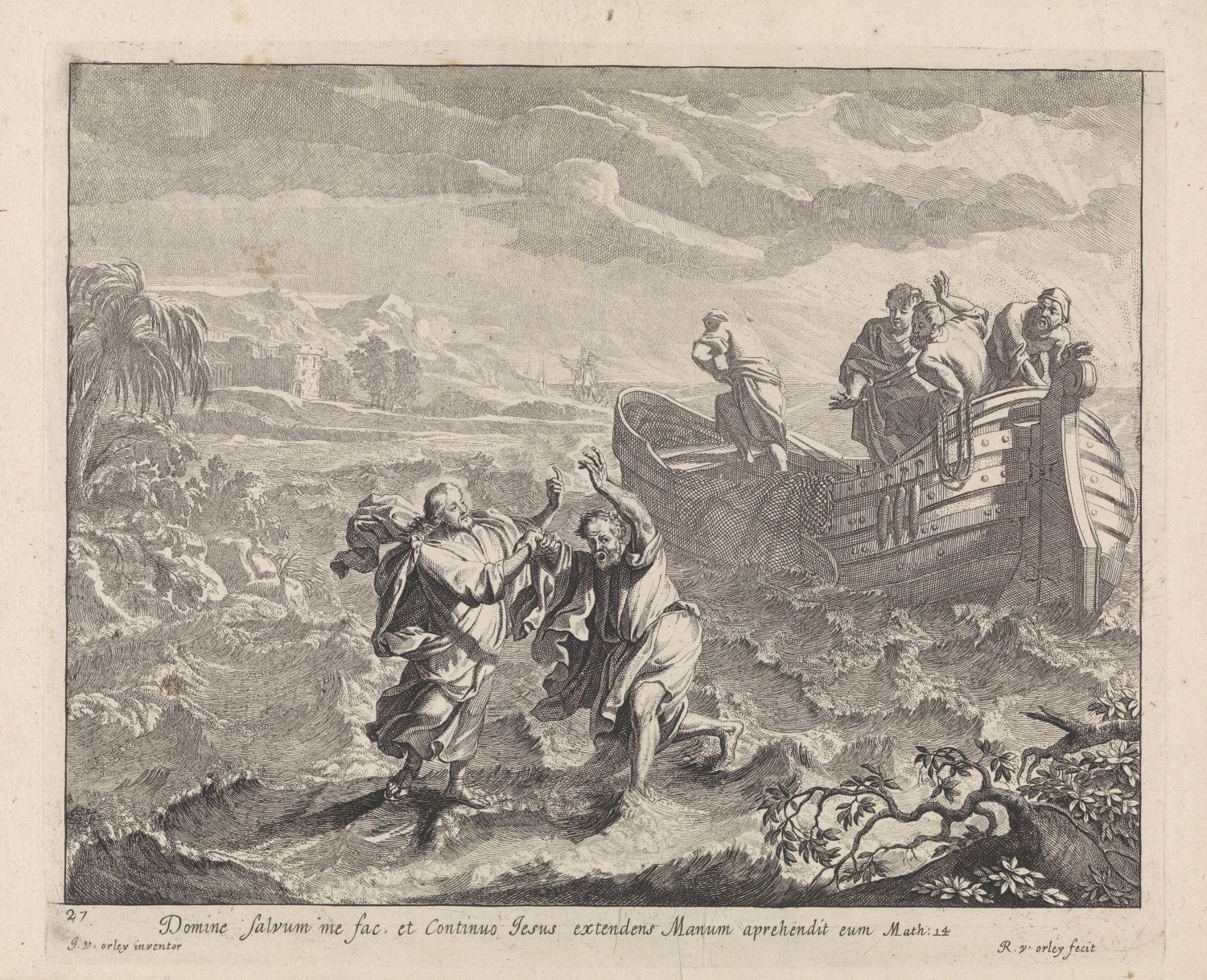
Christ Walks on Water, Etching by Jan van Orley
1 Søren Kierkegaard, Practice in Christianity, ed. and trans. Howard V. Hong and Edna H. Hong, Kierkegaard’s Writings, vol. 20 (Princeton: Princeton University Press, 1991), 252.

